Poland's Energy Data Hub Goes Fully Live on 19 October. What Will It Show About Your Data?
On 19 October, the last Polish market participants moved to CSIRE. From then on, your metering and contract data is compared daily with everyone else's.
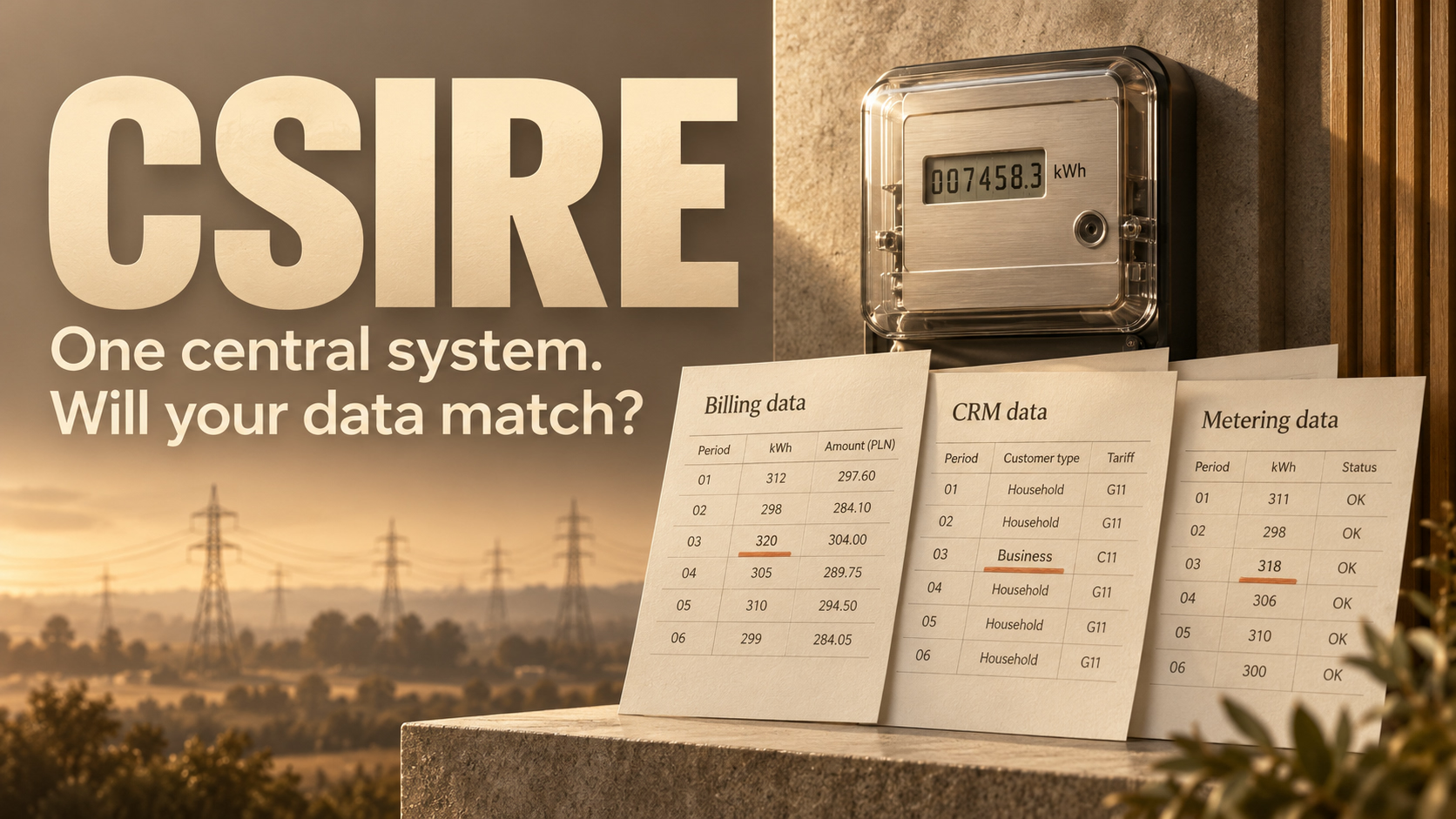

For a long time, I viewed central data hubs as purely technical, managed by IT with minimal business impact. I shared this view with others in the energy industry, but I was mistaken. The main point of this article is to explain why. A central hub is not just new infrastructure; it acts as a mirror, revealing issues that are often overlooked.
What is actually the case on 19 October?
CSIRE has operated since 1 July 2025, with distribution system operators and suppliers joining in phases. The final deadline is 19 October 2026. After this date, all processes covered by law, such as supplier switching and metering data exchange, will be managed through a single central system instead of bilateral arrangements. For example, a supplier switch should take about 24 hours, which is a significant change from current practices. Notably, in September 2026, parliament allowed the President of URE to waive penalties for distribution operators who miss the 19 October deadline for technical or organizational reasons, provided they integrate by 19 April 2027 and settlements can use data from outside CSIRE if systems fail. While the legal deadline remains, the market will experience a six-month transition where some parties are fully integrated and others are not, leading to increased mismatches.
Consider the scale: Polish distribution operators manage about 19.5 million electricity meters. As of July 2026, approximately 11 million, or 56 percent, are smart meters with remote reading. The legal target is 80 percent by the end of 2028. The central system will launch as the volume of measured data increases rapidly, with each reading assigned a single, common address.
What makes a shared system more demanding than a private one?
The point I want you to take from this article is this: prior to CSIRE, each company maintained its own version of the market picture—that is, its own list of metering points, its own recordThe key message is this: before CSIRE, each company maintained its own version of the market, including lists of metering points, customer associations, contract dates, and tariff codes. Discrepancies between versions were usually resolved privately between back offices, often after weeks, and rarely became visible outside those teams. This approach allowed errors, such as incorrect identifiers or outdated customer records, to persist for years without consequences.s instead of weeks. A switch which should take a day fails since the metering point identifier doesn't match. A settlement is based on readings that your own systems do not recognise. A customer calls to find out why their new supplier can't see their meter. These are no new problems; what is new is that the mirror now shows them to all people at the same time.
What are the usual origins of these mismatches?
In my experience, when companies must share data with a larger, more rigorous partner, challenges usually stem from master data, not the integration process itself. In the energy sector, four key areas require attention.
First, identifiers such as metering point numbers, customer IDs, and contract IDs often exist in multiple systems without reconciliation, resulting in inconsistent lists across billing, CRM, and meter data systems. Second, dates and statuses, including contract periods and switch statuses, may be recorded in one system but assumed in another. Third, free text is sometimes used instead of standardized codes for tariff groups, address formats, or change reasons, which a central system with fixed dictionaries cannot accept. Fourth, there is often no clear lineage for readings, with estimated and actual values mixed together and lacking clear identification, making it difficult to trace data origins.
These problems are solvable, but integration projects do not address them directly. The solution is to designate a source system for each data item, clean the data accordingly, and regularly monitor for discrepancies.
What was I going to do before 19 October?
If your company is joining on 19 October or has already joined but still faces rejected processes, do not start with another round of connection testing. Instead, conduct a quick assessment: compare your list of active metering points with data from billing, CRM, meter data, and CSIRE, and count discrepancies by type. The resulting proportion of mismatches reveals your readiness more effectively than any test certificate and highlights priority issues to address.
Next, ensure there is a single agreed source for each data element, implement automatic checks before data leaves your systems, and clearly flag whether each reading is measured or estimated. Our platforms typically include a modeling layer with versioned and tested definitions, as well as a lineage view that allows users to trace disputed values back to their source within minutes. As discussed in The Market Moved to Fifteen Minutes. Has Your Data?, market rules may change on a set date, but underlying data only changes when someone updates it.
CSIRE will benefit the Polish market by enabling faster switching, providing a single source of truth for metering points, and reducing paperwork between companies. However, in the initial months, companies that prepared before 19 October will benefit most.
I encourage every company joining CSIRE to consider this: if you compared your metering point lists across billing, CRM, and meter data today, what percentage would match on the first attempt?
Sources: PSE, 19 października 2026 r. kolejne podmioty rozpoczną realizację procesów przez CSIRE, 02.10.2026; wnp.pl, Senat bez poprawek do noweli prawa energetycznego, 24.09.2026; energetyka.expert, CSIRE od 19 października 2026; e-magazyny.pl, CSIRE wchodzi w ostatni etap, 24.08.2026; ŚwiatOZE, CSIRE działa od pół roku; e-magazyny.pl / PTPiREE, smart meters, 04.09.2026