The Market Moved to Fifteen Minutes. Has Your Data?
Europe’s electricity market runs on quarter-hour intervals. Many companies still reconcile forecasts, meters, and margins by the hour. The gap hides the causes of imbalance costs.


On 1 October 2025, Europe’s coupled day-ahead electricity market moved from hourly to fifteen-minute pricing, which means that a typical day now has 96 price intervals instead of 24. Trading systems had to adapt to the new auction format, but that does not necessarily mean the forecasts, contracts and financial reports behind them began working at the same level of detail.
Nearly a year later, as the industry meets at EuroPOWER in Warsaw and Enlit Europe in Vienna to discuss flexibility, storage and AI, I think it is worth asking how far that change has reached inside the companies that generate, supply, store and consume electricity, particularly where the trading desk works in quarter-hours but the rest of the business still relies on hourly data. Cadvel will be attending both events, and I look forward to discussing how energy companies are adapting their data and reporting to the quarter-hour market.
What changes when the market moves to fifteen minutes?
The balancing side of the market got there first, since European rules require a fifteen-minute imbalance settlement period and Poland introduced it on 14 June 2024 as part of the balancing market reform, while the intraday market has traded quarter-hour products for years. With the day-ahead market following, the whole chain from the auction to the imbalance bill is now priced in the same fifteen-minute unit, which in practice means 96 prices per day and 35,040 per year instead of 8,760, and on the two days when the clocks change, 92 or 100 intervals instead of 96, which is the kind of detail that looks trivial until a report built on the assumption that every day has 96 rows meets the last Sunday of October.
What matters more than the arithmetic is that the price is no longer flat inside the hour. Solar ramps, morning load increases and battery dispatch all have a shape within the hour, and the quarter-hour market now prices that shape explicitly, so an hourly average, which used to be a reasonable simplification, has become a way of hiding exactly the information the market is paying for. Forecasting providers were quick to point out that a trader now needs four forecasts per hour instead of one and that the finer market is more sensitive to anomalies and outliers, and in my opinion the same sentence applies to every system in the company that touches energy data, not only to the forecasting model.
Where does the hour still hide inside the company?
The market-facing systems were upgraded because they had to be, since nobody can submit quarter-hour bids with software that only understands hours. The problem, in my experience, sits one or two layers behind the trading desk, in the places the market reform did not force anyone to touch: demand forecasts trained on years of hourly history, customer contracts and PPAs with hourly profiles, meter data arriving from distribution system operators in one format and settlement data from the transmission system operator in another, controlling that calculates margin per hour or per day, and reporting that aggregates everything to hours because the template was built that way in 2019 and nobody has had a reason to change it. Each of these systems is correct on its own terms, and that is exactly why the problem is so hard to see, because the loss does not live inside any single system but in the translation between them.
One imbalance bill, five disconnected data sources
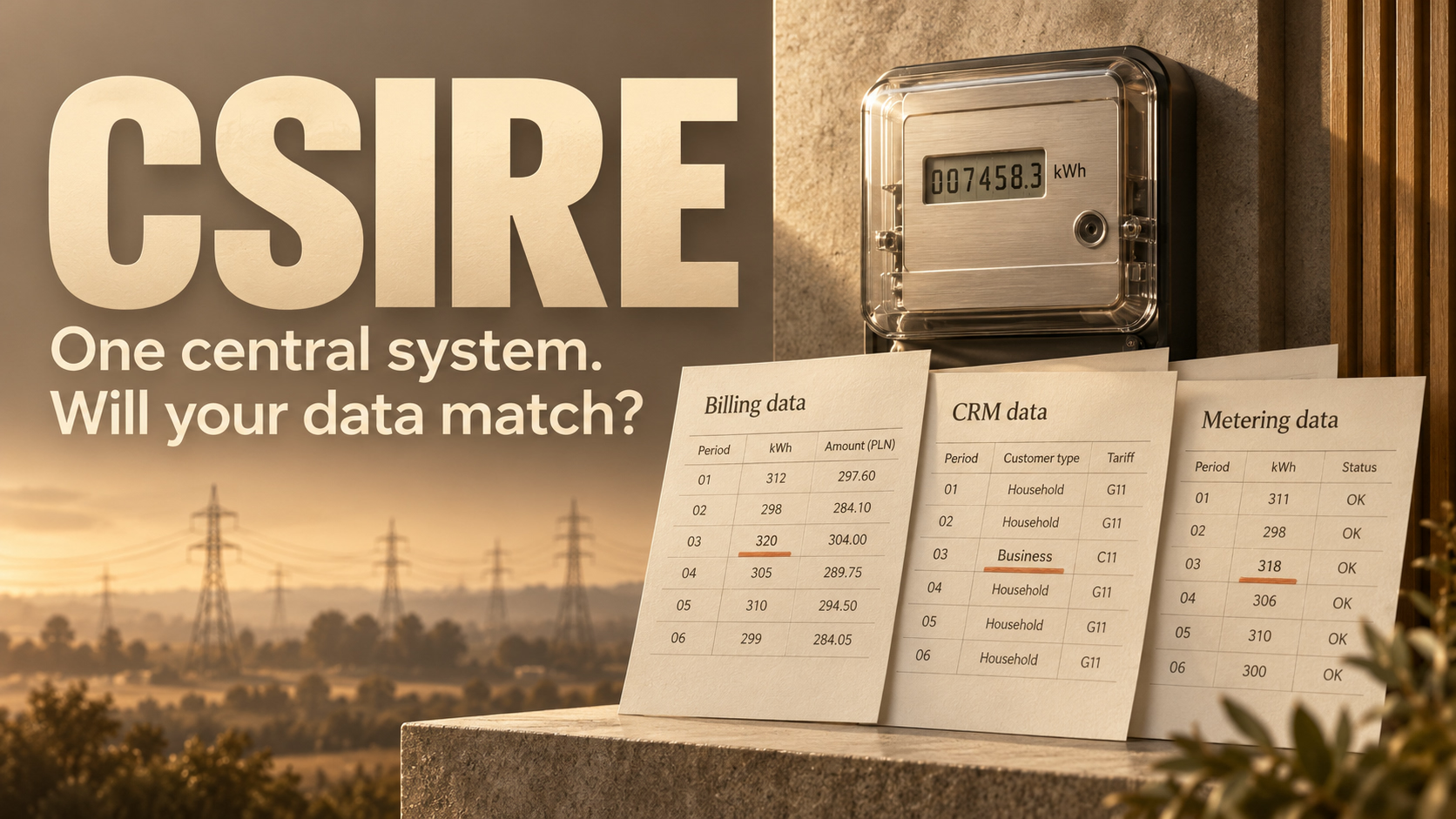
Consider, as an illustration rather than a client case, a mid-sized supplier or an industrial consumer with its own solar installation and a battery. Its settlement from the grid operator arrives per quarter-hour, its consumption forecast is hourly, its meters report partly in fifteen-minute profiles and partly in hourly or standard profiles, the battery schedule lives in the vendor's platform, and the finance team sees imbalance cost as one line in the monthly result. When that line grows, nobody can say with confidence whether the cause was the forecast, the battery schedule, a gap in meter data, or a price spike in six specific quarter-hours on a sunny Sunday afternoon, because the data needed to answer the question exists in five places at three different granularities, and the person who reconciles it by hand in a spreadsheet needs a week to produce an answer that arrives after the next month has already been settled. I have described the same pattern in manufacturing and in finance, and I believe energy is no different: the data exists, and a person with a spreadsheet has quietly become the integration layer between the systems.
What does it take to close the gap?
The principles are less exotic than the problem, and I would put them in the following order. The first is to store every signal at the finest granularity at which it is produced and to aggregate only at the moment someone needs a coarser view, because an hourly average can always be computed from four quarter-hours, but four quarter-hours can never be recovered from an hourly average, and every pipeline that aggregates on ingestion destroys information the market is now paying for. The second is one time model for the whole company, with UTC underneath, local time on top, the clock-change days handled explicitly, and the same interval key used by market data, meter data, forecasts, contracts and settlement, so that a quarter-hour means the same thing in trading, in operations and in finance.
The third principle is continuous reconciliation of your own data against the official settlement data, interval by interval, with differences flagged before the settlement deadline rather than discovered after the invoice, and with lineage that shows where each number came from, because an imbalance cost you cannot trace to a source is a cost you cannot dispute or reduce. The fourth is to measure the gap before trying to close it, and I would start with three numbers: how many of the systems that touch energy data still work in hours, what share of last month's imbalance cost can be explained interval by interval, and how many working days it takes to reconcile a month.
The tools matter less than the shared time model
The technology behind this is mature and, at these volumes, not particularly exotic: columnar databases such as ClickHouse handle years of quarter-hour time series from thousands of meters comfortably, a platform such as Snowflake joins them with contracts, customers and finance, and a modelling layer such as dbt keeps the definitions versioned and testable. In my opinion, however, the choice of tool is the smaller decision, and the larger one is organisational, namely deciding that the quarter-hour is the unit of truth for the whole company and not only for the trading desk.
What should change, measurably
When this foundation holds, the results are concrete: imbalance cost explained by cause rather than reported as one monthly line, reconciliation measured in hours instead of days, and investment decisions about flexibility, better forecasting or an additional battery taken on the basis of which quarter-hours actually cost money, rather than on an hourly picture that averages the problem away. There is also a second effect that I think will matter more over the next few years, because every AI initiative in energy trading and flexibility, from price forecasting to automated battery dispatch, will learn from the company's quarter-hour history, and a model can only be as precise as the data it was trained on. The market moved to fifteen minutes a year ago, and the question I would ask in every energy company preparing its plans for 2027 is simple: in which of our systems is it still, quietly, one hour?
Sources: EPEX SPOT, Successful implementation of 15-minute MTU in SDAC; URE, second stage of the balancing market reform, 14 June 2024; Dexter Energy, SDAC 15-minute MTU transition; Next Kraftwerke, The day-ahead market switches to 15-minute products